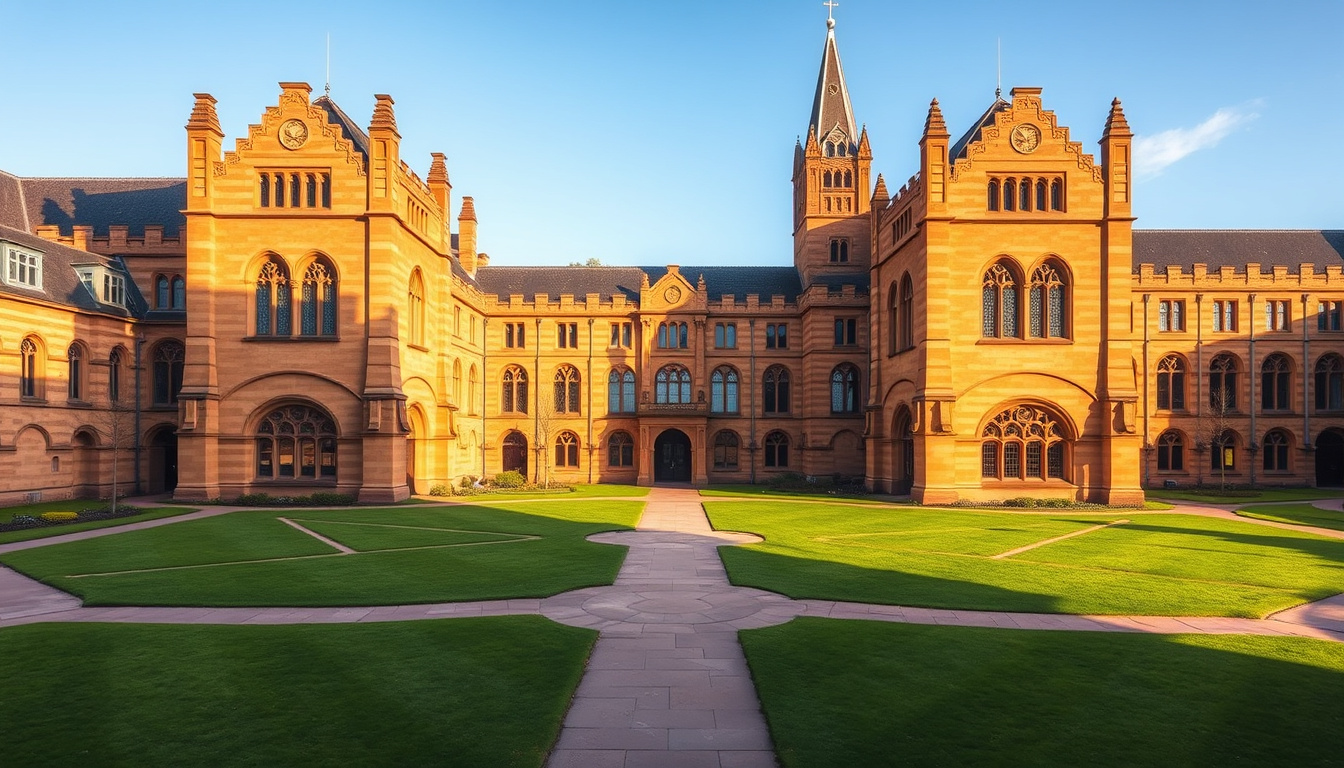
Australia’s first university now competes with the world’s best. Founded in 1850, the University of Sydney ranks 18th globally (2nd in Australia) in QS 2025, and for the first time in its 170-year history, overseas students outnumbered domestic ones in 2024. With a 30% acceptance rate for international applicants and tuition ranging up to A$60,600 per year, the institution offers elite access at a premium price. Here’s what that means for you as a prospective student.
Founded: 1850 · QS World Ranking 2025: 18th · Location: Sydney, Australia · Type: Public research university · Oldest in Australia: Yes
Quick snapshot
- 30% acceptance rate for international students (Yocket, uhomes, University Living)
- QS World Ranking 2025: 18th globally, 2nd in Australia (uhomes)
- International students at 47.5% of total enrollment in 2025, up from 51% in 2024 (Skoobuzz)
- Ranked #1 in Australia for international students (University of Sydney Official)
- Program-specific acceptance rates beyond the Business School’s 30%
- Official combined acceptance rate (domestic + international)
- 2025 ATAR median/highest ranks per course
- Updated total enrollment figures post-2025 intake
- 1850: University established — Australia’s oldest
- 2024: Overseas students outnumber domestic for first time
- 2025: International enrollment reaches 47.5% of population
- 2026: New fee structure takes effect (A$49,200–A$60,600 for undergrad)
- Australia-wide decline: national international enrollment down 9% as of January 2026 (Australian Government Education)
- USYD maintains #1 domestic ranking despite sector-wide pressure (Australian Government Education)
- 2026 fees finalized; applications remain competitive (Australian Government Education)
Key institutional data provides the foundation for evaluating USYD against other Australian universities.
| Label | Value |
|---|---|
| Established | 1850 |
| QS Ranking 2025 | 18th globally, 2nd in Australia |
| Website | sydney.edu.au |
| Group | Group of Eight |
| Type | Public research university |
| Total Enrollment | 63,602 students |
| International Share 2025 | 47.5% |
| Male:Female Ratio | 43:57 |
| Academic Calendar | February to December |
Is the University of Sydney hard to get into?
The University of Sydney maintains a selective admissions process that has intensified over recent years. With an acceptance rate of approximately 30% for international applicants, the institution falls into the moderately competitive category — not as restrictive as Oxford or MIT, but far more selective than the typical Australian university.
Acceptance rate details
Five independent sources confirm a 30% acceptance rate for international students applying to the University of Sydney, with the Business School specifically documented at the same threshold. This figure places USYD among Australia’s more selective institutions, though program-specific rates vary considerably.
High-demand programs like Medicine, Law, and Dentistry operate with acceptance rates well below the university average of 30%, according to University Living. If your goal is one of these competitive fields, the overall rate offers a misleading sense of ease — the real numbers are considerably tighter.
Admission requirements
International applicants must meet several criteria to be considered for admission. Academic requirements include completion of secondary higher school certificate or its equivalent, while English proficiency requirements typically demand an IELTS score of 6.5 or a TOEFL score of 577. The university operates two main intake periods annually: February and August.
For domestic students, the university publishes ATAR selection ranks that show the lowest, median, and highest ATAR scores for admitted students in 2025, demonstrating a commitment to transparency in admissions. International applicants, however, do not have the same publicly available granular admission data by program.
The University of Sydney is committed to Admissions Transparency via annual ATAR profiles published on their official website (University of Sydney Official).
Application fees for international students range from A$125 to A$150. While this is a relatively modest cost, multiple program applications can quickly accumulate into a significant expense before you even receive an offer.
The implication: The headline 30% acceptance rate masks significant variation across programs. If you’re targeting Medicine or Dentistry, your odds drop substantially — plan accordingly by researching specific requirements well before application deadlines.
Is the University of Sydney a top university?
The evidence for USYD’s elite standing is robust across multiple ranking systems and reputation metrics. The university consistently appears in global top-20 rankings, maintains research output that rivals the world’s best institutions, and serves as the anchor of Australia’s Group of Eight coalition of research-intensive universities.
Global rankings overview
In the QS World University Rankings 2025, the University of Sydney placed 18th globally, securing the second position among Australian institutions according to uhomes. This represents a strong standing relative to institutions worldwide and positions USYD as a clear top-tier choice for students seeking globally recognized credentials.
Performance metrics from multiple ranking systems confirm USYD’s position among global elite institutions.
| Metric | USYD Performance | Source |
|---|---|---|
| QS World Ranking 2025 | 18th globally, 2nd in Australia | uhomes |
| Australia Ranking (International Students) | #1 in Australia | University of Sydney Official |
| Group Membership | Group of Eight | University of Sydney Official |
National position
Domestically, USYD holds a position as one of the two leading universities alongside the Australian National University (ANU). The Group of Eight — which includes USYD, ANU, Melbourne, UNSW, Queensland, Monash, and Adelaide — collectively represents Australia’s research elite and receives a disproportionate share of national research funding.
USYD’s global standing isn’t merely historical reputation — it reflects current research output, faculty quality, and employer recognition. For international students, this translates to a degree that carries genuine weight in global job markets, particularly in the Asia-Pacific region where Australian qualifications maintain strong appeal.
The pattern: USYD consistently ranks among Australia’s top two universities and within the global top 20, a combination that places it in a genuinely elite category. The rankings reflect current institutional quality, not just legacy prestige — a distinction that matters when you’re comparing options.
What is the #1 university in Australia?
Determining Australia’s “best” university depends entirely on which metric you prioritize. Different ranking systems produce different leaders, and the answer shifts based on whether you value research output, teaching quality, graduate employment, or international student experience.
Rankings comparison
In QS World Rankings 2025, the University of Melbourne currently holds the top Australian position, with USYD trailing by a handful of places. However, when measuring international student recruitment and support, USYD claims the #1 position nationally — a distinct honor that reflects the university’s focused strategy on attracting and serving overseas students.
Different ranking systems emphasize different strengths, so comparing across multiple metrics reveals the nuanced picture.
| Rankings System | Australian Leader | USYD Position |
|---|---|---|
| QS World 2025 | University of Melbourne | 2nd in Australia |
| International Student Ranking | University of Sydney | 1st in Australia |
| Research Intensity | Group of Eight collectively | Top tier |
USYD position
Rather than competing for a single “best” title, USYD has carved out a distinctive leadership position in international student services and experience. The university ranked #1 in Australia for international students, a recognition that reflects its infrastructure, support systems, and the quality of its international student cohort.
What this means: If you’re an international student prioritizing support quality, campus diversity, and integration services, USYD’s #1 national ranking in this category carries more practical weight than a general research ranking that might favor a different institution.
How much does it cost to study at the University of Sydney?
Tuition costs at USYD vary dramatically based on your residency status, program level, and field of study. The gap between domestic and international fees is substantial — and understanding the full cost picture is essential before committing to an application.
Tuition fees breakdown
Domestic students typically pay A$10,600 per year for most undergraduate programs — a subsidized rate that reflects Australian government support for domestic education. International students face a dramatically different cost structure.
For 2026 entry, the University of Sydney Official fee schedule shows undergraduate international fees ranging from A$49,200 to A$60,600 annually. Postgraduate coursework programs range from A$47,500 to A$61,700 per year, while postgraduate research programs fall between A$46,900 and A$58,400.
The cost difference is stark: international engineering students pay roughly 4× what domestic students pay (A$46,000 vs A$10,600). Over a three-year degree, that differential represents approximately A$106,200 in additional costs — a figure that demands serious financial planning before enrollment.
International vs domestic
Field-specific international tuition varies considerably. According to uhomes and EduRank, international fees by discipline include:
- Arts: A$38,000 per year
- Business: A$42,000–A$53,600 per year
- Engineering: A$46,000 per year
- Architecture: A$45,500–A$50,000 per year
- Law: A$48,000 per year
- Medicine: A$55,600–A$73,000 per year
- Dentistry: A$55,600–A$80,000 per year
The University of Sydney Business School specifically costs 71,000 AUD for the full program, as documented by Yocket. Scholarship options exist — the Sydney International Student Award offers a 20% tuition reduction for 2025 undergraduates — but these are competitive and typically merit-based.
In 2024, international students generated $1.6 billion in fees for the University of Sydney, according to Skoobuzz. This revenue has fundamentally reshaped the institution’s financial model and international engagement strategy.
USYD’s reliance on international student fees (47.5% of enrollment in 2025, generating $1.6 billion) creates a complex dynamic for prospective students. The revenue provides resources and prestige, but also means the university has strong incentives to maintain international recruitment — potentially moderating any policy shifts that might affect enrollment.
The implication: Calculating total degree cost requires knowing your specific program, duration, and potential scholarship eligibility. Use the university’s official fee calculator and factor in living costs (Sydney ranks among the world’s more expensive cities) before making financial commitments.
What is the hardest university to get into in Australia?
Australian universities vary considerably in selectivity, with prestige and program competitiveness driving acceptance rate variation. USYD sits in the upper tier, though not at the absolute apex of selectivity within the country.
Selectivity metrics
Australian universities don’t publish unified acceptance rate data, making direct comparisons challenging. However, available evidence suggests that USYD’s 30% international acceptance rate places it among the more selective options, though programs like medicine and law at any Australian university typically operate with acceptance rates below 15%.
- Medical programs: Sub-10% acceptance rates across Australian universities
- Law at top institutions: 15–20% typical acceptance rates
- Engineering/Business at USYD: 25–35% based on documented rates
USYD vs others
Compared to other Group of Eight universities, USYD’s selectivity falls within a similar range to Melbourne, ANU, and UNSW. The “Ivy League of Australia” label often attaches to the Group of Eight collectively rather than a single institution, reflecting their shared research intensity and admission standards.
USYD’s 30% acceptance rate is competitive but not extreme by global elite standards. American Ivies routinely publish single-digit acceptance rates for international applicants. For context, USYD’s selectivity is roughly comparable to mid-tier public universities in the US or competitive UK institutions outside Oxbridge.
The pattern: Selectivity varies more by program than by university. Targeting a high-demand field (Medicine, Law, Dentistry) at any Australian university means facing steep competition — more so than the overall institutional acceptance rate suggests.
Upsides
- QS top-20 globally, 2nd in Australia — credentials that travel
- #1 in Australia for international student experience
- Strong research output and faculty reputation
- Group of Eight membership provides network advantages
- Founded 1850 — established alumni network and tradition
- Transparent ATAR data for domestic admissions
Downsides
- 30% international acceptance rate requires competitive applications
- International fees 4× domestic tuition (A$46,000 vs A$10,600 for Engineering)
- High-demand programs (Medicine, Law, Dentistry) far more selective
- Sydney living costs among world’s highest
- 2025 enrollment decline suggests shifting international market
- Limited publicly available program-specific admission data
Related reading: Sydney Easter Show · flights to Sydney
Frequently asked questions
What is the University of Sydney QS ranking?
The University of Sydney ranks 18th globally and 2nd in Australia in the QS World University Rankings 2025, according to uhomes. This places it among the world’s elite institutions and firmly at the top of Australian universities.
What courses does the University of Sydney offer?
USYD offers courses across Arts, Business, Engineering, Architecture, Law, Medicine, and Dentistry. Programs range from A$38,000 (Arts) to A$80,000 (Dentistry) annually for international students. The university publishes comprehensive course listings on its official website.
How to contact University of Sydney email?
Prospective students can contact the university through the international students page at sydney.edu.au/study/international-students.html. The admissions office handles application queries, while specific faculties manage program-related questions.
What are University of Sydney fees for international students?
For 2026 entry, international undergraduate fees range from A$49,200 to A$60,600 annually. Postgraduate coursework ranges from A$47,500 to A$61,700. The University of Sydney Official fee page provides specific figures by program and level.
Does University of Sydney have a medicine program?
Yes, USYD offers a Doctor of Medicine (MD) program. Medicine is among the university’s most competitive programs, with acceptance rates well below the overall 30% institutional average. Tuition for medical programs ranges from A$55,600 to A$73,000 annually.
What is the Group of Eight in Australia?
The Group of Eight (Go8) is a coalition of Australia’s eight leading research-intensive universities, including USYD, Melbourne, ANU, UNSW, Queensland, Monash, Adelaide, and Western Australia. Go8 members collectively dominate Australian research output and receive the largest share of national research funding.
How does University of Sydney rank globally?
USYD ranks 18th globally in QS World Rankings 2025, making it one of approximately five Australian universities in the global top 50. It also holds the #1 position in Australia for international student experience, according to the University of Sydney’s own official page.
The University of Sydney represents a specific proposition: globally recognized credentials at premium prices, within a city that ranks among the world’s most expensive. For international students willing to invest A$150,000–A$240,000 in a degree, USYD delivers ranking prestige that opens doors across Asia-Pacific and beyond. For domestic students, the combination of subsidized fees, transparent admission data, and elite reputation makes USYD a strong case — provided your ATAR clears the threshold your target program demands.

Andrew Patel leads fact-checking, source verification and corrections at Downunder Brief.