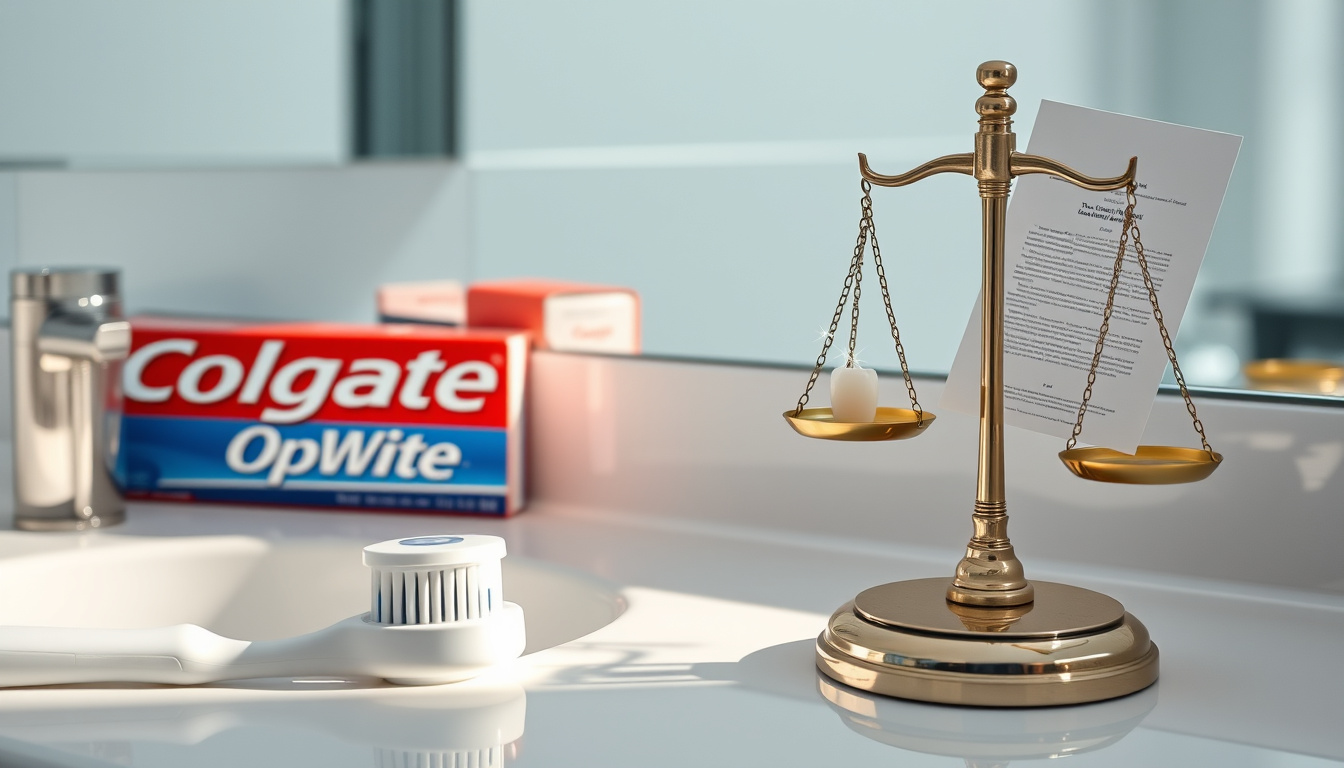
If you’ve ever stood in a pharmacy aisle comparing toothpastes, Colgate Optic White’s bold “clinically proven” whitening claims probably caught your eye. The tube promises visibly whiter teeth in just 3 days. But a series of class action lawsuits and dentist warnings suggest that promise may not hold up to scrutiny. This article unpacks what Colgate Optic White actually does, why regulators and courts have taken notice, and what dental professionals say about using it.
Whitening Claim: Visibly whiter in 3 days ·
Hydrogen Peroxide: 1% (standard formula) ·
Surface Stains: Up to 100% removed ·
Lawsuit Allegation: Doesn’t deeply whiten
Quick snapshot
- Contains 1% hydrogen peroxide (CA Dental Group)
- Multiple lawsuits allege false deep-whitening claims (Top Class Actions)
- Judge denied Colgate’s motion to dismiss in 2015, allowing class claims forward (Bursor & Fisher)
- Whether lawsuits reached settlement or final resolution
- Long-term enamel impact from daily use
- Independent clinical trials comparing Optic White to other whitening toothpastes
- Misrepresentation claims began October 2013 (Top Class Actions)
- Court ruling June 17, 2015 allowed class claims to proceed (Bursor & Fisher)
- Heavy metals complaint amended May 28, 2025 (Hagens Berman)
- FTC review stalled, class actions still pending (Global Cosmetics News)
- Competitor P&G sued Colgate in Australia over Optic White claims (Global Cosmetics News)
- Heavy metals litigation adds separate concern for Colgate toothpaste lines (Global Cosmetics News)
| Attribute | Value |
|---|---|
| Active Ingredient | Hydrogen Peroxide (up to 5% in Pro Series, 1% standard) |
| Claimed Results | Whiter in 3 days |
| Stain Removal | 100% surface stains |
| Price Range | 75ml tube ~€3-5 |
| Lawsuit Status | Class action on deep whitening claims ongoing |
| Key Case | Vigil v. Colgate (4:17-cv-00929), 2017 |
| Court Ruling | Motion to dismiss denied June 17, 2015 |
| Australian Challenge | P&G v. Colgate over Optic White Renewal claims |
Does Colgate Optic White really whiten teeth?
Colgate Optic White markets itself with a straightforward promise: whiter teeth from the first brushing, with results visible within 3 days. The brand’s advertising includes language like “clinically proven to whiten with peroxide beyond surface stains,” a claim that has become central to multiple legal challenges.
Clinical claims
Colgate Optic White Pro Series contains 5% hydrogen peroxide, while the standard formula contains 1% (CA Dental Group). A peer-reviewed study published in PMC NCBI found that Colgate Optic White reduced enamel roughness, though some metrics showed no significant changes (PMC NCBI). The study’s findings suggest surface-level effects rather than deep structural whitening.
Surface vs deep whitening
The core allegation in multiple lawsuits is that Optic White removes surface stains through mild abrasion but cannot penetrate below the tooth surface to address intrinsic staining. Dentists state that peroxide toothpastes cannot remove intrinsic deep stains due to short contact time—the toothpaste rinses away before meaningful bleaching can occur (Top Class Actions).
The Academy of General Dentistry representatives have gone further, stating that the term “whitening” itself is misleading when applied to toothpastes because they rinse away before the active ingredients can take effect (Top Class Actions). The implication is clear: consumers paying premium prices for Optic White may be receiving surface cleaning rather than genuine whitening.
What is the Colgate Optic White lawsuit?
Multiple class action lawsuits have targeted Colgate-Palmolive over its Optic White advertising, with plaintiffs alleging the brand makes false claims about deep whitening capabilities. These cases span U.S. federal courts and have drawn attention from the Federal Trade Commission.
Class action details
Melissa L. Vigil filed a class action lawsuit in 2017 (Case No. 4:17-cv-00929) in the U.S. District Court for the Northern District of California, alleging that Colgate Optic White falsely claims to penetrate below the tooth surface for deep whitening when it only removes surface stains via abrasion (Top Class Actions). The lawsuit proposed a class of California purchasers who paid premium prices based on these deep-whitening promises.
Sharon Willis filed a separate class action (Case No. 2:19-cv-08542) on October 3, 2019, in the U.S. District Court for the Central District of California. Willis claims Colgate Optic White has been misrepresented since October 2013 and does not deeply whiten or affect intrinsic stains (DrBicuspid). At least two prior Colgate Optic White lawsuits had been filed in New York and California, with advertising under FTC investigation (Top Class Actions).
Allegations vs evidence
Judge Jesus Bernal issued a pivotal ruling on June 17, 2015, denying Colgate’s motion to dismiss and allowing nationwide class claims to proceed under California consumer laws (Bursor & Fisher). Judge Bernal stated: “Colgate moved to dismiss Dean’s plainly well-pleaded Complaint… Nothing did.”
In Australia, Procter & Gamble Oral B filed a separate lawsuit challenging Colgate’s Optic White Renewal claims of removing a decade’s worth of yellowing in 4 weeks as lacking scientific basis (Global Cosmetics News). P&G contends Optic White provides only minor whitening, not a major effect on internal stains. The FTC review of Optic White claims stalled or delayed class action complaints, according to Citeline Insights (Citeline Insights).
The pattern across multiple lawsuits is consistent: peroxide concentration is too low (1%) and contact time is insufficient to achieve the deep whitening Colgate advertises. Plaintiffs across different courts cite the same fundamental science.
How long does it take for Colgate Optic White to work?
Colgate’s marketing promises visible results within 3 days, with some product variants (like the Pro Series) claiming more aggressive whitening through higher peroxide concentrations. But experts and courts have questioned whether these timelines are achievable through toothpaste alone.
Pro Series results
The Colgate Optic White Pro Series contains 5% hydrogen peroxide, compared to 1% in the standard formula. While this is a higher concentration, experts note that proper whitening requires holding peroxide against teeth for hours—a protocol incompatible with brushing. According to Dr. William DeVizio, Colgate’s former VP Clinical Research and current Chief Dental Officer: “Toothpastes with hydrogen peroxide for whitening don’t really help much. Because the toothpaste gets all over your mouth… you probably won’t brush long enough” (DrBicuspid).
Daily use expectations
Multiple lawsuits cite the same issue: peroxide concentration is too low and contact time insufficient to achieve meaningful deep whitening. CA Dental Group notes that the 1% concentration in standard Optic White rinses away quickly and dilutes in the mouth, making deep whitening chemically implausible (CA Dental Group). Lori Canale’s lawsuit alleges the toothpaste promises to “deeply whiten more than 3 shades” but fails to deliver due to this low peroxide concentration.
Consumer reports describe years of use with “no changes in teeth” despite paying premium prices for Optic White Renewal. The FTC review remains stalled, meaning no regulatory resolution is imminent.
Is it okay to use Colgate Optic White every day?
Colgate markets Optic White as safe for daily use, with marketing emphasizing enamel protection alongside whitening benefits. However, dental professionals raise concerns about abrasive particles in whitening formulas and the overall effectiveness of daily peroxide exposure through toothpaste.
Enamel protection
Colgate claims Optic White helps keep enamel strong and gums healthy. The peer-reviewed study found the toothpaste reduced enamel roughness rather than increasing it (PMC NCBI). However, the American Dental Association spokesperson warned that abrasive whitening toothpastes can wear enamel, exposing yellower dentin underneath (ClassAction.org). The charcoal variant of Optic White has been specifically alleged as abrasive, potentially damaging enamel and dental implants.
Dentist recommendations
CA Dental Group states that the best whitening results come from dentist office treatments, not toothpaste—regardless of brand claims or peroxide concentration (CA Dental Group). Dentists note that daily use of whitening toothpaste may provide mild surface cleaning but cannot substitute for professional protocols designed to hold active ingredients against tooth surfaces for meaningful periods.
Daily use of Colgate Optic White may provide surface stain removal, but the same mild abrasion that cleans surface stains can, over time, thin enamel—particularly with charcoal variants. The whitening benefit may come at a cost to long-term dental health.
Why do dentists say not to use whitening toothpaste?
Not all dentists oppose whitening toothpaste categorically, but many express skepticism about dramatic whitening claims and caution about potential abrasive effects. The dental profession’s concerns center on chemical limitations, abrasion risks, and misleading marketing language.
Potential risks
Dentists identify two primary concerns with whitening toothpastes: chemical ineffectiveness and physical abrasion. As noted by experts in multiple lawsuit filings, peroxide toothpastes “abrade surface stains but cannot remove intrinsic deep stains due to short contact time” (Top Class Actions). The Academy of General Dentistry considers the term “whitening” itself misleading for toothpastes that rinse away before taking effect.
Regarding physical risks, ADA representatives have stated that using abrasive materials in toothpaste can “actually make your teeth look more yellow, because it can wear away the tooth’s enamel” (ClassAction.org). Charcoal-based variants of whitening toothpaste receive particular criticism for their abrasive profiles.
Alternatives
Dental professionals generally recommend professional whitening treatments for patients seeking meaningful results. These treatments use higher peroxide concentrations (typically 10-40%) held against teeth via custom trays for 30-60 minutes per session. Some dentists endorse whitening strips (which hold peroxide against teeth for extended periods) as a middle ground between toothpaste and professional treatment.
For patients who prefer to stick with toothpaste, dentists typically recommend fluoride-based formulas for daily use, with whitening treatments reserved for periodic professional sessions rather than continuous at-home use through whitening toothpaste.
| Product Variant | Active Ingredient | Concentration | Key Claim |
|---|---|---|---|
| Optic White Standard | Hydrogen Peroxide | 1% | Visibly whiter in 3 days |
| Optic White Pro Series | Hydrogen Peroxide | 5% | Deeper whitening, 3-day results |
| Optic White O2 | Oxygen-powered | Not disclosed | Deep clean, oxygen action |
| Optic White Purple | Optic brighteners | Not disclosed | Instant visual effect |
| Optic White Strips | Hydrogen Peroxide | Varies | Professional-level whitening at home |
| Optic White Charcoal | Abrasive + peroxide | Not disclosed | Surface stain removal via abrasion |
Upsides
- Removes surface stains effectively through mild abrasion
- Contains fluoride for everyday dental hygiene
- Available without prescription at standard retail prices
- Multiple variants suit different preferences and budgets
- Reduced enamel roughness in controlled study conditions
Downsides
- Cannot deliver deep whitening due to insufficient peroxide contact time
- Multiple class action lawsuits allege false advertising
- Premium pricing based on unproven deep-whitening claims
- Charcoal variants may be abrasive enough to damage enamel
- FTC investigation stalled with no regulatory resolution
What experts say about Colgate Optic White
“Toothpastes with hydrogen peroxide for whitening don’t really help much. Because the toothpaste gets all over your mouth… you probably won’t brush long enough.”
— Dr. William DeVizio, former VP Clinical Research and current Chief Dental Officer (DrBicuspid)
“The [toothpaste] is likely to provide only a minor teeth whitening effect and will not provide a major teeth whitening effect on stains… that is measurable against 10 years of yellow stains.”
— Procter & Gamble, plaintiff in Australian lawsuit against Colgate Optic White claims (Global Cosmetics News)
“Using abrasive materials in toothpaste can actually make your teeth look more yellow, because it can wear away the tooth’s enamel.”
— American Dental Association spokesperson (ClassAction.org)
Colgate Optic White is marketed by a company whose own former VP of Clinical Research publicly stated that peroxide toothpastes don’t work as marketed. The disconnect between internal expertise and external advertising underscores why multiple courts have allowed consumer lawsuits to proceed.
How does Colgate Optic White compare to alternatives?
Three whitening approaches dominate the consumer market: whitening toothpaste (like Optic White), take-home strips and trays, and professional in-office treatments. Each operates on different principles with markedly different results.
The fundamental physics of peroxide whitening requires extended contact between active peroxide and tooth enamel. Whitening toothpaste cannot achieve this because toothpaste rinses away within minutes. Strips and trays hold peroxide against teeth for hours, enabling genuine bleaching. Professional treatments use highest concentrations combined with light or heat activation for maximum penetration.
| Whitening Method | Peroxide Concentration | Contact Time | Expected Results | Cost |
|---|---|---|---|---|
| Whitening Toothpaste (Optic White) | 1-5% | 2-3 minutes brushing | Surface stain removal only | $3-15 per tube |
| Whitening Strips | 6-14% | 30-60 minutes daily | 1-3 shades lighter | $30-60 per kit |
| Take-Home Trays | 10-15% | Hours during sleep | 3-6 shades lighter | $100-400 |
| Professional In-Office | 25-40% | 15-60 minutes per session | 5-8 shades lighter | $300-1,000+ |
Consumers paying premium prices for Colgate Optic White expecting professional-level whitening will be disappointed. The product excels at surface stain removal but cannot match the mechanism that makes strips, trays, and in-office treatments effective: sustained peroxide contact time.
The bottom line on Colgate Optic White
Colgate Optic White removes surface stains and may produce a slightly brighter appearance through mild abrasion and optic brighteners. What it cannot do is deliver the deep, intrinsic whitening its marketing language implies. Multiple courts have allowed consumer lawsuits to proceed based on this disconnect between advertised claims and scientific reality.
The pattern is consistent across lawsuits in the U.S. and Australia: peroxide concentration is too low, and contact time is too short for toothpaste to achieve meaningful deep whitening. Colgate’s own former VP of Clinical Research has publicly confirmed this limitation. For consumers seeking genuine whitening results, professional treatments or properly designed take-home products offer the sustained peroxide contact that toothpaste cannot provide.
For anyone who has spent years paying premium prices for Colgate Optic White expecting visible shade changes, the class action lawsuits represent a legitimate avenue for recourse. The legal proceedings continue, with no resolution in sight as the FTC investigation remains stalled.
Related reading: Chemist Warehouse Townsville · Campsie Medical Centre
While Colgate Optic White faces questions over whitening efficacy, Colgate Total 12 benefits delivers comprehensive antibacterial protection for daily oral hygiene needs.
Frequently asked questions
What is the number 1 rated teeth whitening toothpaste?
Independent dental comparisons rarely crown a single “number 1” product because effectiveness varies by stain type and individual factors. Most dental professionals agree that no whitening toothpaste can match professional treatments for deep whitening. Among toothpaste options, those with the ADA Seal of Acceptance provide evidence-backed surface cleaning without harmful abrasives.
Can yellow teeth go white again?
Surface stains (extrinsic discoloration from coffee, wine, smoking) respond well to whitening toothpaste and professional cleaning. Intrinsic stains (deeper discoloration from aging, medications, trauma) require professional peroxide treatments that penetrate tooth structure. Yellow teeth caused by thinning enamel exposing dentin underneath cannot be whitened with toothpaste—the underlying structural issue must be addressed through dental procedures.
What do NHS dentists use to whiten teeth?
NHS dentists in the UK offer professional tooth whitening using higher-concentration peroxide gels applied in custom-fitted trays. This is classified as a dental treatment requiring clinical assessment. NHS-approved whitening uses carbamide peroxide (which releases hydrogen peroxide) at concentrations requiring professional supervision. NHS practices do not recommend or endorse over-the-counter whitening toothpaste as a substitute for clinical treatment.
Does Colgate Optic White contain peroxide?
Yes, Colgate Optic White contains hydrogen peroxide. The standard formula contains 1% concentration, while the Pro Series variant contains 5%. Both concentrations are significantly lower than professional whitening treatments (10-40%) and contact time is measured in minutes rather than hours, limiting deep whitening effectiveness.
What are the ingredients in Colgate Optic White?
Colgate Optic White ingredients include water, sorbitol, hydrated silica, sodium lauryl sulfate, flavor, hydrogen peroxide (1-5% depending on variant), sodium fluoride, and various polishing agents and binders. Specific ingredient lists vary by product variant (standard, Pro Series, charcoal, etc.). The peroxide concentration is the key active whitening ingredient.
Is Colgate Optic White safe for enamel?
Research published in PMC NCBI found that Colgate Optic White reduced enamel roughness in controlled study conditions, suggesting no immediate enamel damage. However, ADA representatives warn that abrasive whitening toothpastes can wear enamel with long-term use. The charcoal variant has been specifically alleged in lawsuits as damaging to enamel and dental implants. For daily long-term use, dentists generally recommend fluoride toothpaste without whitening abrasives.
How much does Colgate Optic White cost?
Colgate Optic White pricing varies by retailer and variant. Standard 75ml tubes typically retail for €3-5 in European markets and $4-8 USD in the US. Pro Series and specialty variants command higher prices, typically $10-15 per tube. The premium pricing is based on the deep-whitening claims central to the ongoing class action litigation.

Andrew Patel leads fact-checking, source verification and corrections at Downunder Brief.