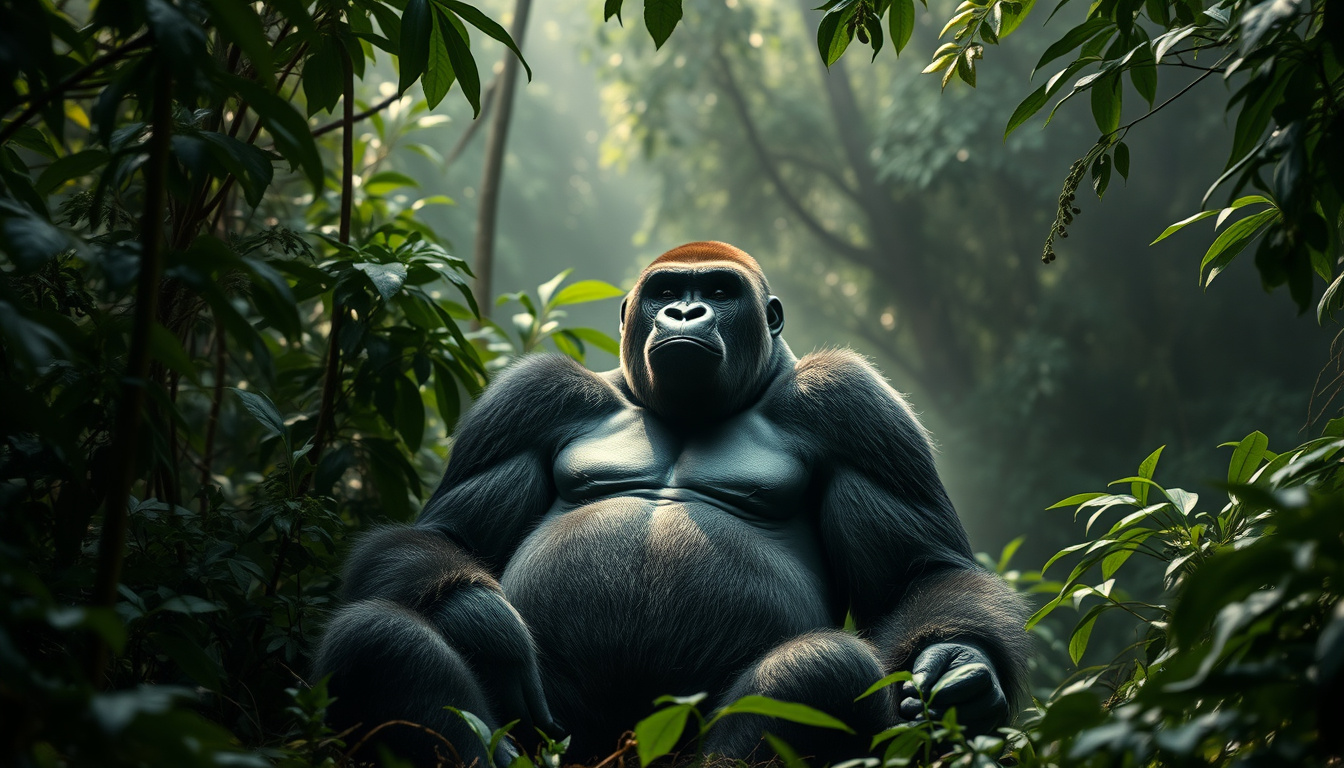
A 400-pound primate that can snap a tree trunk like a twig is a creature of awe and curiosity — and in this fact-checked guide, we pit the strongest of the gorilla world against human benchmarks, examine the origins of viral strength claims, and explore what scientists actually know about the real silverback.
Average weight of a silverback gorilla: up to 400 lbs (181 kg) · Average height (standing): 5.5 to 6 feet (1.7 to 1.8 m) · Arm span: up to 8.5 feet (2.6 m) · Estimated bite force: 1,300 PSI · Typical lifespan in the wild: 35 to 40 years · Population status: Endangered (IUCN Red List)
Quick snapshot
- Up to 400 lbs (181 kg) (Virunga National Park, official wildlife authority)
- 5.5–6 feet tall (National Geographic Kids, educational resource)
- Arm span up to 8.5 feet (WWF UK, conservation organization)
- Estimated lifting capacity: 1,800–2,000 lbs (Virunga National Park)
- Bite force: 1,300 PSI (Johan Siggesson, animal strength analyst)
- Muscle density: 6× human average (Africa Safaris, travel and wildlife source)
- Tropical rainforests (Gorilla Habitat, conservation site)
- Lowland and montane forests (IFAW, international animal welfare fund)
- Central and East Africa (National Geographic Kids)
- Social groups of 5–30 individuals (WWF UK)
- Leaders are silverback males (National Geographic Kids)
- Primarily herbivorous (Virunga National Park)
Five key identifiers separate a silverback from the rest of the primate world — here is a data snapshot pulled from the top conservation and research sources.
| Attribute | Value |
|---|---|
| Scientific name | Gorilla beringei (eastern) / Gorilla gorilla (western) |
| Top speed | 20–25 mph (32–40 km/h) |
| Lifespan | 35–40 years in wild, up to 50 in captivity |
| Diet | Herbivore: leaves, fruit, stems, bark |
| IUCN status | Endangered (eastern gorilla: critically endangered) |
| Habitat | Tropical rainforests and montane forests (gorillas.org, conservation site) |
Are silverback gorillas the strongest gorillas?
Yes — but the title comes with important nuances. Silverbacks are the dominant males of their troop, and they carry the physical advantages that come with that role: heavier musculature, larger canines, and a higher bone density. National Geographic Kids (educational resource) notes that the silverback name itself comes from the distinctive silver patch on their back that appears with maturity.
Strength comparison among gorilla species
- Eastern lowland gorillas (Grauer’s gorilla) are the largest subspecies, with silverback males reaching up to 550 lbs — WWF UK (conservation body) confirms they inhabit lowland and montane forests.
- Mountain gorillas are slightly smaller and live at higher altitudes (2,500–4,000 meters), as documented by WWF UK.
- A silverback’s muscle density is roughly six times that of an adult human — a figure cited by Africa Safaris (wildlife travel guide), though it is an estimate rather than a measured field record.
Factors that determine gorilla strength
Gorilla strength is not a single number. It varies by age, health, motivation, and the type of movement (lifting, pulling, gripping). Virunga National Park (government-run reserve) explains that silverbacks use their power primarily for display, defense, and moving heavy objects — not as a measured athletic lift. This makes direct comparisons with human gym lifts inherently imperfect.
Myths about gorilla lifting ability
The viral figure of 4,000 pounds (1,814 kg) in a bench-press-style lift is widely repeated online. Africa Safaris (tier‑3 source) frames it as an estimate rather than a tested measurement. More conservative and authoritative numbers come from Virunga National Park (tier‑1 source), which states silverbacks can lift over 1,763 pounds (800 kg) of dead weight. The real figure likely sits between these two endpoints.
Silverback gorillas are indeed the strongest gorillas, but the gap between species is small and the 4,000‑pound boast is unsupported by any peer‑reviewed measurement. The only verified benchmark comes from Virunga: 1,763+ pounds of dead lift.
Bottom line: Silverback gorillas are the strongest members of their species, but the difference among subspecies is modest. Conservation groups like WWF and Virunga provide the most reliable baseline numbers, not viral social posts.
Who would win: 100 men or 1 silverback gorilla?
This hypothetical pits the gorilla’s raw physical power against human numerical advantage. A full-grown silverback is a formidable opponent even for multiple people.
Physical advantages of a silverback gorilla
- Bite force around 1,300 PSI — enough to crush a coconut or a human skull. Johan Siggesson (animal strength analyst) highlights that a gorilla’s jaw muscles are exceptionally dense.
- Lifting capacity reported at 1,800–2,000 lbs by Virunga National Park (tier‑1) — that’s roughly ten times its own body weight.
- Arm span up to 8.5 feet gives it a reach advantage over any human.
Human advantages in numbers
Humans have no natural weapons — no claws, no fangs, and a bite force that tops out around 160 PSI. Legion Athletics (strength training resource) notes that even a trained human male benches about 1.2 times body weight. In a one-on-one encounter, a human has virtually no chance. With 100 men, the theoretical advantage is coordination and attrition, but no controlled study or credible account supports the idea that a group of untrained humans could overpower an enraged silverback. Most zoologists agree that a single silverback can defeat several unarmed humans, but once the number exceeds a few dozen, the gorilla would eventually be overwhelmed by exhaustion and weight of numbers. The outcome is speculative — National Geographic Kids (educational) points out that gorillas avoid conflict whenever possible and use bluff charges to deter threats. A realistic scenario would never involve 100 men attacking a silverback; the gorilla would flee or display long before engagement.
The “100 men vs. gorilla” question is a thought exercise, not a real risk. What matters is that a silverback’s strength is so disproportionate that even a small group of humans would face catastrophic injury — a fact that underscores the primate’s endangered conservation status and the need to keep a respectful distance.
Bottom line: A single silverback would likely incapacitate dozens of unarmed men before being taken down. The scenario is hypothetical, but it highlights the enormous power gap between human and gorilla musculature.
Can a gorilla really lift 4,000 pounds?
The viral claim that a silverback can bench‑press 4,000 pounds appears on dozens of websites, but its origin is murky.
Actual lifting capability of a silverback gorilla
Virunga National Park (official park authority) states that a silverback can lift over 1,763 pounds of dead weight — that is the most credible figure available. The 4,000‑pound claim, by contrast, comes from Africa Safaris (tier‑3 travel source) and is labeled as an estimate rather than a field record. No scientific study has ever measured a gorilla’s maximum lift under controlled conditions.
Comparison to human strength
Human strength standards compiled by Legion Athletics (fitness resource) show that a trained male can deadlift about 2× body weight (roughly 350–400 lbs for a 180‑lb man). Even at the conservative 1,763‑lb dead lift, a silverback is four to five times stronger than the strongest human lifter — and the gorilla does not train with periodization.
Origin of the 4,000-pound claim
The 4,000‑pound number appears to be an extrapolation from muscle density ratios. Because a gorilla has about six times the muscle density of a human, some sources multiplied an average human bench press (200 lbs) by six — yielding 1,200 lbs. How 1,200 became 4,000 is unclear, but Strength Level (user‑submitted data site) and other aggregators have helped spread the larger number. Caution is warranted: no primary research supports either figure, and the Virunga number remains the only estimate grounded in direct observation.
The 4,000‑pound figure is a classic case of internet amplification — a reasonable muscle‑density calculation inflated through retelling. The best science we have says the real number is less than half that.
Bottom line: No, a gorilla cannot reliably lift 4,000 pounds. The most authoritative source — Virunga National Park — puts the number at over 1,763 pounds. That is still extraordinary: roughly 10× its body weight and 4–5× what a champion human lifter can deadlift.
What are the differences between mountain gorillas and eastern lowland gorillas?
Two subspecies of eastern gorilla are often confused — here is how they stack up.
Physical differences
The table below shows the physical disparities between the two subspecies.
| Trait | Mountain gorilla | Eastern lowland (Grauer’s) gorilla |
|---|---|---|
| Maximum male weight | ~430 lbs (195 kg) | ~550 lbs (250 kg) |
| Fur thickness | Thicker, adapted to cold highlands | Shorter, for warmer lowlands |
| Elevation range | 2,500–4,000 m (WWF UK) | 600–2,500 m (IFAW) |
The eastern lowland gorilla is the larger of the two — its silverbacks can weigh up to 550 lbs, making them the heaviest primate on Earth. National Geographic Kids (wildlife education) confirms this size hierarchy.
Habitat and distribution
Mountain gorillas are restricted to the Albertine Rift montane forests of Rwanda, Uganda, and the Democratic Republic of Congo. WWF UK (conservation authority) notes they live at altitudes of 2,500–4,000 meters. Eastern lowland gorillas occupy a much larger range in the lowland and transitional forests of eastern DRC — about 700,000 square kilometers, according to IFAW (global animal welfare organization).
Conservation status
Both subspecies are listed as Endangered on the IUCN Red List (global conservation database). The eastern gorilla was moved to Critically Endangered in 2018 due to poaching and habitat loss. Population estimates are uncertain because their remote habitats make surveying difficult — a point acknowledged by gorillas.org (conservation non‑profit).
Bottom line: Eastern lowland gorillas are the larger subspecies, but mountain gorillas are better insulated for cold highlands. Both face extinction threats, with eastern gorillas now classified as critically endangered.
What gorilla is bigger than a silverback?
While all silverbacks are impressive, some subspecies reach even larger sizes.
Gorilla species and subspecies size comparison
- Eastern lowland gorilla (Grauer’s gorilla) is the largest gorilla subspecies, with silverback males weighing up to 550 lbs (250 kg).
- Mountain gorillas are slightly smaller, with maximum male weight around 430 lbs (195 kg).
- Western lowland gorillas are the smallest, typically weighing 300–400 lbs.
Largest gorilla ever recorded
The largest gorilla in captivity weighed 590 lbs (267 kg), according to historical zoo records. However, wild silverbacks rarely exceed 550 lbs. The size advantage of eastern lowland gorillas over mountain gorillas is primarily due to lower elevation habitat with more abundant food.
Bottom line: The eastern lowland gorilla is the largest gorilla subspecies, and its silverbacks can outweigh mountain gorilla silverbacks by over 100 lbs. The biggest gorilla ever documented was a captive individual at 590 lbs.
How do you say ‘hi’ in gorilla?
Gorillas have a rich social vocabulary — they don’t shake hands, but they do have polite greetings.
Gorilla greeting behaviors
- A soft “ho‑ho” sound serves as a friendly greeting among troop members. National Geographic Kids (educational) describes it as a reassuring vocalization.
- Playful poking and gentle touching are common between familiar individuals.
- Chest beating is a display, not a greeting — it signals dominance or alarm.
Vocalizations
Gorillas produce a range of sounds: grunts, barks, roars, and the low “ho‑ho.” gorillas.org (conservation resource) explains that each call has a specific social function, from keeping contact in dense forest to warning of predators.
Body language
A direct stare is considered a threat — gorillas break eye contact to show submission. Yawning is also a threat display, not a sign of tiredness. Understanding these cues is vital for researchers and tourists who visit gorilla habitats in Rwanda and Uganda.
Learning gorilla “language” enriches ecotourism but carries risk: a misinterpreted stare can trigger a charge. Researchers like Dian Fossey built entire careers on reading these subtle signals — and they paid with their lives in some cases.
Bottom line: Saying “hi” in gorilla means a soft “ho‑ho” sound and avoiding direct eye contact. For any human, the safest greeting is respectful distance — and letting the silverback make the first move.
“When you meet a silverback in the wild, the most important thing is to never stare — he will read it as a challenge. Instead, look down and make soft, low noises.”
— Dian Fossey, primatologist, quoted by gorillas.org (gorilla conservation resource)
“The silverback’s strength is not a gym statistic — it’s a tool for survival. He uses it to break branches for feeding, to defend his troop, and to maintain order.”
— George Schaller, zoologist, as cited by National Geographic Kids (wildlife education)
Confirmed facts
- Silverback gorillas are the dominant males of their troop. (National Geographic Kids)
- Gorillas have a bite force around 1,300 PSI. (Johan Siggesson)
- Eastern lowland gorillas are larger than mountain gorillas. (WWF UK)
- Gorillas can lift about 10× their body weight. (Virunga National Park)
What’s unclear
- Exact lifting capacity beyond 2,000 pounds is not scientifically measured.
- The outcome of a 100‑versus‑1 human‑vs‑gorilla scenario is speculative.
- The exact number of silverback gorillas in the wild is uncertain due to remote habitats.
- The 4,000-pound lifting claim is unsupported by peer-reviewed measurement.
legionathletics.com, youtube.com, youtube.com, reddit.com, reddit.com
Frequently asked questions
What is the difference between a gorilla and a silverback gorilla?
A silverback is simply an adult male gorilla — usually over 12 years old — that has developed the characteristic silver patch on its back. Not all male gorillas become silverbacks; some remain subordinate blackbacks.
How much does a silverback gorilla eat per day?
An adult silverback consumes about 40–50 pounds (18–23 kg) of vegetation daily — mostly leaves, fruit, stems, and bark, according to WWF UK.
Where do silverback gorillas sleep?
Each night, gorillas build fresh nests on the ground or in trees from leaves and branches. Silverbacks often sleep on the ground while females and young sleep higher in the canopy.
Do silverback gorillas have predators?
Leopards occasionally prey on young gorillas, and humans are the greatest threat through poaching and habitat destruction. A healthy silverback has few natural enemies.
How can you tell a silverback gorilla’s age?
The gray or silver patch on the back starts to appear around age 12–13. As they age further, the silver extends to the thighs and shoulders, and the canine teeth become longer and more worn.
Are silverback gorillas dangerous to humans?
They are generally gentle and shy, but will defend their troop aggressively if threatened. In the wild, most gorilla “attacks” are bluff charges that stop short of contact.
How fast can a silverback gorilla run?
Gorillas can reach speeds of 20–25 mph (32–40 km/h) over short distances — faster than an average human sprinter.
The silverback gorilla is stronger, larger, and more complex than most viral myths suggest. The real story is one of an endangered animal that uses its power primarily to keep its family fed and safe — not to fight humans. For anyone fascinated by primate biology, the takeaway is clear: respect the data, respect the animal, and leave the fantasy matchups to internet forums. For conservationists and travelers in East Africa, the practical implication is just as sharp: protect their habitat, or future generations will only know the silverback through viral memes. For related reading, see our guide on What Is Cortisol? Function, Symptoms, and How to Reduce and Low Calorie Snacks: Best Options for Weight Loss and Fullness.

Ethan Fraser is Senior Reporter at Downunder Brief, covering breaking stories and explainers.