
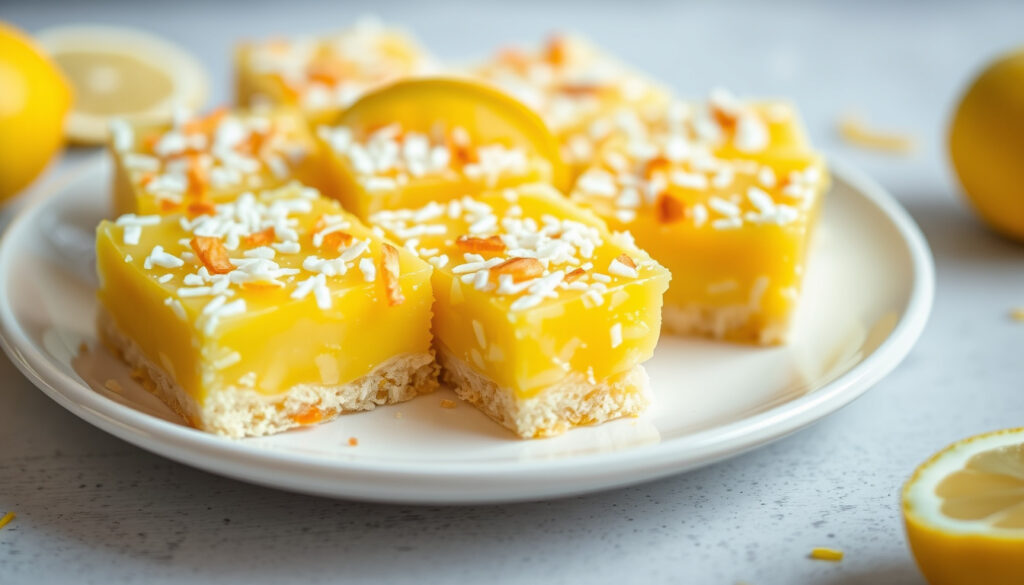
Australian mornings wouldn’t be the same without the tangy-sweet zing of a properly made lemon slice. This no-bake classic—built on crushed biscuits, sweetened condensed milk, and fresh lemon—has been a pantry staple for generations because it requires no oven, no mixer, and delivers results in under 15 minutes.
No-Bake Method: Yes ·
Key Ingredient: Sweetened Condensed Milk ·
Prep Time: 15 Minutes ·
Common Base: Crushed Biscuits ·
Top Variation: Lemon Coconut
Quick snapshot
- Condensed milk, crushed biscuits, lemon juice topping (Sweetest Menu recipe blog)
- Baked base, lemon curd, tart finish (The-Cooking-Nook community forum)
- Lemon rind in base, simple icing, coconut flakes (Kakadu Plum Co native ingredient blog)
- Minimal prep, no oven, pantry staples (Frugal and Thriving budgeting blog)
Key specifications vary across sources, but the core profile stays consistent.
| Attribute | Value |
|---|---|
| Primary Type | No-Bake Slice |
| Common Prep Time | 15-20 Minutes |
| Chill Time | 2-4 Hours |
| Servings | 16-20 Pieces |
| Key Flavor | Tangy Lemon with Sweet Coconut |
| Preferred Biscuit | Arnott’s Marie |
| Condensed Milk | Full-Fat Recommended |
| Typical Tray Size | 30cm × 20cm or 18cm × 28cm |
Lemon Coconut Slice
This is the recipe that defines the category in Australia—the no-bake lemon slice with a biscuit base and a tangy lemon topping. Sweetest Menu (a recipe blog specializing in sweet treats) describes it as “a simple no-bake Lemon Slice made with fresh lemons, sweetened condensed milk and coconut.”
Ingredients
- 300g plain sweetened biscuits, crushed (3 cups according to Sweetest Menu)
- 100g desiccated coconut
- Zest of 2 lemons
- 60g melted butter
- 240ml sweetened condensed milk
- 2-3 tablespoons lemon juice
The biscuit base works best when the mixture resembles wet sand after combining all ingredients, according to Sweetest Menu. This texture ensures the slice holds together when cut but still melts in your mouth.
No-Bake Steps
- Process biscuits and coconut together until you reach your desired texture
- Add melted butter, condensed milk, lemon zest, and juice
- Mix until evenly combined
- Press firmly into a lined slice tray (30cm × 20cm or 18cm × 28cm per VJ Cooks)
- Refrigerate until set, typically 2-4 hours
- Top with lemon icing if desired
One detail that matters: full-fat condensed milk sets firmer than skim varieties. Bake Play Smile (an Australian baking blog) explicitly tests and recommends full-fat for the best texture.
For home bakers who want that signature no-bake texture, the ratio of crushed biscuits to coconut is what separates a crumbly mess from a clean-cut slice. Stick to 3 cups biscuit to 100g coconut, and you’ll get slices that hold their shape without drying out.
Chilling Time
Most recipes agree on 2-4 hours minimum refrigeration. The base needs time to firm up before icing. According to Kakadu Plum Co, their lemon myrtle variant requires 1-1.5 hours just for the base alone before the icing layer goes on.
Easy Lemon Recipes with Few Ingredients
Part of the appeal of no-bake lemon slice is how few pantry staples it requires. You probably already have most of what you need.
Minimal Ingredient List
- Biscuits (any plain sweet variety works)
- Sweetened condensed milk
- Lemon (or bottled juice)
- Butter
- Coconut (optional in some versions)
That’s it. Frugal and Thriving (an Australian budgeting blog) demonstrates how minimal this recipe can get: their version uses exactly 4 ingredients—half a pack of scotch finger biscuits, 300ml whipping cream, half a cup of lemon juice, and a 297g can of condensed milk. No coconut, no butter.
Quick Assembly
- Crush biscuits (or leave whole in minimal versions)
- Whip cream to soft peaks (for 4-ingredient version)
- Fold in condensed milk and lemon juice
- Pour into dish or slice into squares
- Refrigerate until set
This approach skips the food processor entirely. Frugal and Thriving notes that bottled lemon juice works as a viable substitute for fresh in this version—which matters when you’re out of fresh lemons.
No electric mixer needed. No food processor. No oven. This makes lemon slice one of the most accessible baking-adjacent recipes you can make with a basic kitchen setup—useful for school lunches, office morning teas, or last-minute gatherings.
No Mixer Needed
The traditional biscuit-base method requires nothing more than a wooden spoon or spatula. The key is ensuring the butter is properly melted so it binds everything together. Caroline’s Cooking (a home cooking blog) recommends melting butter and condensed milk together before adding to dry ingredients for a smoother result.
The trade-off: the heated method takes an extra 5 minutes but produces a more cohesive base, while the cold-melt method is faster but requires more elbow grease to combine evenly.
Old Fashioned Lemon Squares Recipe
Not all lemon slice recipes skip the oven. One baked variation exists that some prefer for a firmer, more cake-like texture.
Traditional Base
- Butter, caster sugar, egg, self-raising flour
- Shortbread-style crust baked at 180°C (350°F)
- Cool before adding topping
This baked version appears as an outlier in the recipe landscape. The-Cooking-Nook (a community cooking forum) documents this variation, which uses a traditional shortbread base rather than crushed biscuits.
Lemon Curd Topping
- Butter, sugar, eggs, lemon juice and zest
- Cooked until thick
- Poured over cooled base and baked again
The result is more tart and less sweet than the no-bake version, with a curd-like layer that sets firmly. This appeals to those who prefer a more pronounced lemon flavor without the coconut.
Baked lemon bars require more time and attention—roughly 45 minutes total versus 15 minutes for no-bake. If you’re after that quick-fix simplicity that makes no-bake slice so popular, the baked version loses that advantage.
Baking Option
If you do want to try the baked route, expect two separate baking periods: one for the base (about 20 minutes), and one for the topping (another 20-25 minutes). Caroline’s Cooking notes that the no-bake version “is a traditional Australian no-bake bar with a coconut-cookie base”—emphasizing that the no-bake method is what defines the category in its home market.
The pattern: baked squares are more work but deliver a different textural experience. No-bake is faster and more forgiving.
Simple Lemon Recipes
Beyond the standard coconut slice, there are several ways to customize the flavor profile. These simple variations keep the no-bake method intact.
Basic Steps
- Choose your biscuit base (Arnott’s Marie is the Australian standard)
- Select your liquid binder (butter + condensed milk, or cream + condensed milk)
- Add lemon component (juice for tang, zest for aroma)
- Press, refrigerate, and ice if desired
Bake Play Smile specifically recommends Arnott’s Marie biscuits as the preferred brand in Australia, along with full-fat condensed milk and fine desiccated coconut. Three sources confirm this combination.
Fresh Lemon Zest
Lemon zest does more than add visual flecks—it brings aromatic oils that bottled juice simply can’t replicate. Women’s Weekly Food (an established Australian food publication) uses 1 teaspoon of lemon rind in their base alongside half a cup of condensed milk and 250g of plain sweet biscuits.
For those who love a zesty bite, upping the zest to a full lemon’s worth intensifies the flavor without adding sweetness.
Icing Tips
- Icing sugar, butter, lemon juice—sifted smooth
- Apply only when base is firmly set
- Let sit 30 minutes at room temperature before slicing
- For lemon myrtle version: add 1/2 teaspoon lemon myrtle powder to icing
Sweetest Menu details a standard icing of icing sugar, butter, and lemon juice that’s sifted for smoothness. The key is ensuring the base is cold and firm before icing—otherwise the icing soaks in and you lose that clean glaze effect.
Adding icing adds visual appeal and a hit of sweetness, but it also adds sugar and an extra 30-minute wait before serving. For a quicker version, skip the icing and dust lightly with icing sugar instead—or serve plain for a more tart, less sweet experience.
Lemon Slice Recipe Basics
Every good lemon slice starts with understanding the core components. Once you know why each ingredient matters, you can adapt with confidence.
The ingredient table below breaks down purpose and typical amounts across Australian recipes.
| Ingredient | Purpose | Typical Amount |
|---|---|---|
| Sweetened condensed milk | Binding + sweetness | 240-395ml depending on recipe |
| Plain sweet biscuits | Base structure | 200-300g |
| Butter | Moisture + flavor | 60-150g |
| Desiccated coconut | Texture + subtle flavor | 45-100g |
| Lemon juice | Tangy contrast | 2-3 tablespoons |
| Lemon zest | Aromatic boost | 1-2 lemons’ worth |
Sweetest Menu specifically warns against substituting evaporated milk for condensed milk—the sweetness and binding properties differ significantly. Nestle brand sweetened condensed milk is tested and recommended by multiple sources.
The implication: using the right condensed milk matters more than most beginners realize. The difference between a slice that sets properly and one that’s too soft often comes down to whether you used condensed versus evaporated milk.
Preparation Method
- Line your slice tray with baking paper, leaving overhang for easy removal
- Process biscuits and coconut together (VJ Cooks recommends fine crumbs for first packet, chunkier for second)
- Add butter (melted or heated depending on recipe)
- Stir in condensed milk, zest, and juice
- Press evenly and firmly—uneven pressing means uneven slicing
- Refrigerate 2+ hours before cutting
- Ice if desired, then let set another 30 minutes
VJ Cooks suggests processing the first packet of biscuits to fine crumbs with the coconut, then adding larger chunks from the second packet for texture variation. This two-stage approach gives you both binding and crunch.
Pressing too lightly creates crumbly slices that fall apart when cut. Press firmly with the back of a spoon or a flat spatula, applying even pressure across the entire base. A well-pressed base should hold together when you lift it by the baking paper.
Serving Ideas
- Cut into 16-20 small squares for morning tea platters
- Pair with a cup of tea or coffee
- Pack in school lunchboxes (no nuts, travels well)
- Gift in wax paper wrappers for neighbors or colleagues
- Add a dollop of whipped cream for dessert presentation
Sweetest Menu notes that no-bake lemon slice is “quick for morning tea, afternoon tea, school lunches”—flexible enough to serve in any context where a simple sweet treat fits. Chef Not Required puts it at 245kcal per serving, making it reasonable as an occasional indulgence.
A simple no bake Lemon Slice made with fresh lemons, sweetened condensed milk and coconut.
— Sweetest Menu recipe blog
This new and improved no-bake Lemon Coconut Slice recipe is absolutely perfect!
— Bake Play Smile Australian baking blog
Whip up these zesty 4-ingredient lemon condensed milk squares. An easy no-bake Aussie favourite.
— Frugal and Thriving Australian budgeting blog
This lemon slice is a traditional Australian no bake bar with a coconut-cookie base.
— Caroline’s Cooking home cooking blog
Bottom line: Home bakers who value simplicity get the most predictable results from Arnott’s Marie biscuits, full-fat condensed milk, and fine desiccated coconut—three ingredients that established Australian recipe blogs consistently recommend. For those who want even fewer components, the 4-ingredient cream version works, but it produces a fundamentally different dessert.
Related reading: Lemon Coconut Slice · Lemon Slice
Frequently asked questions
How do you store homemade lemon slice?
Refrigerate in an airtight container for up to 5 days. The slice stays firm when cold but softens at room temperature, so serve cold or let sit 10 minutes before eating if you’ve stored it in the fridge.
Can lemon slice be frozen?
Yes. Wrap individual slices in plastic wrap, then place in a freezer bag. Freeze for up to 2 months. Thaw in the refrigerator overnight. The texture may be slightly softer after thawing, but the flavor holds well.
What if I don’t have condensed milk?
Condensed milk is the key binding ingredient, and substituting it is difficult. Some recipes use a heated butter-and-condensed-milk mixture for better binding. You cannot reliably substitute evaporated milk, heavy cream, or sweetened alternatives—each produces a different texture that may not set properly.
Is lemon slice gluten-free?
Traditional recipes use wheat-based biscuits (Arnott’s Marie contains flour). For a gluten-free version, substitute with gluten-free plain sweet biscuits. Verify that your biscuit choice is certified gluten-free, as cross-contamination is common in standard bakery items.
How to make lemon slice dairy-free?
This is challenging because the core binding ingredients (condensed milk and butter) are dairy products. Coconut cream can substitute for condensed milk in some versions, but the result differs significantly in flavor and texture. There is no direct dairy-free equivalent that replicates the standard recipe’s characteristics.
Why is my lemon slice too soft?
Too-soft texture typically comes from one of three causes: insufficient chilling time (needs at least 2 hours), too much liquid in the mixture (measure ingredients precisely), or using skim condensed milk instead of full-fat (full-fat sets firmer). Bake Play Smile explicitly notes that skim milk “works but sets firmer” is incorrect—skim actually sets softer, which may be your issue.
Can I add passionfruit to lemon slice?
Yes. Passionfruit pulp drizzled over the icing adds a tropical twist and balances sweetness with tartness. Add about 2 tablespoons of passionfruit pulp to your lemon icing, or drizzle fresh pulp over finished slices before serving. This variation is popular in Australian summer recipes.

Andrew Patel leads fact-checking, source verification and corrections at Downunder Brief.